Maybe you finished a mold remediation job somewhere else and just want proof the air is actually clean before you move back in. Maybe nobody in the house has visible mold anywhere, but somebody keeps waking up congested every morning. Maybe you manage a rental property and a tenant has raised a concern you need a real answer for, not a guess. Air quality testing gives you an actual reading instead of an assumption.
Call (843) 278-6142 to schedule air quality testing, or fill out the form below and we'll follow up the same day.
What Air Quality Testing Actually Measures
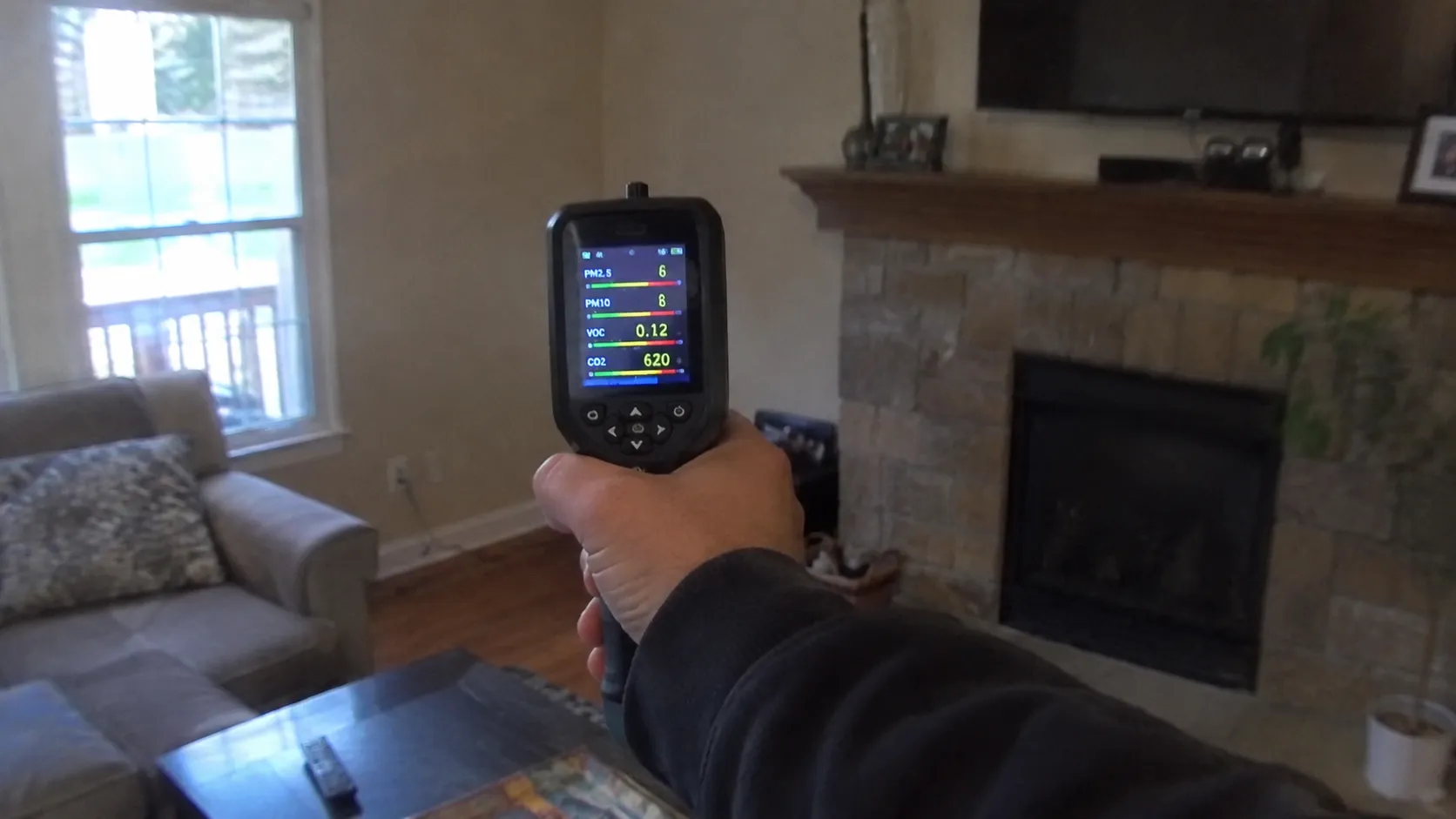
A full indoor air quality check looks at more than one number. Here's what we test for on a typical visit.
Airborne Mold Spore Counts
We collect indoor air samples and compare them against an outdoor baseline sample taken the same day. Spore counts naturally exist outdoors everywhere, so the comparison is what actually tells us whether indoor levels are elevated, not just a raw number on its own.
Humidity and Temperature
ASHRAE guidance recommends keeping indoor relative humidity at or below 65 percent, and the EPA recommends a range of 30 to 60 percent to limit mold growth. We measure both on-site, since Charleston's climate makes it easy for indoor humidity to creep past that range without anyone noticing.
Carbon Dioxide Levels
Elevated CO2 usually points to poor ventilation, which also makes it easier for moisture and spores to build up indoors. ANSI/ASHRAE 62 recommends indoor CO2 stay no more than 700 parts per million above the outdoor level.
Post-Remediation Clearance Testing
If you've had mold removed, whether by us or another company, clearance testing is how you confirm the job actually worked. This is one of the most requested reasons for air quality testing, and for good reason: visible mold being gone doesn't automatically mean the air is clear.
Clearance testing checks that:
- Airborne spore counts in the treated area are back in line with the outdoor baseline
- No cross-contamination happened in areas outside the original work zone
- The moisture source that caused the mold has actually been resolved
We recommend clearance testing as a standard final step on any mold removal job, ours or otherwise. Skipping it means taking someone's word for it instead of having a documented result.
When to Get Air Quality Testing
- After mold remediation, to confirm the air is actually clear before you move back in
- Ongoing allergy or respiratory symptoms with no visible mold source found
- Managing a rental property and need documentation to address a tenant concern
- Buying or selling a property and want a health-focused baseline, separate from a general mold inspection
- A musty smell that comes and goes, making it hard to pin down visually
Air Quality Testing vs. Mold Testing vs. Mold Inspection
These sound similar but answer different questions.
- Mold inspection is the visual and moisture-meter walkthrough that comes first. Details are on our mold inspection page.
- Mold testing identifies a specific species when a visible spot needs to be confirmed. That's covered on our mold testing page.
- Air quality testing looks at the broader indoor environment, humidity, CO2, and spore counts compared to outdoor air, and is the standard way to confirm a space is clear after mold removal or our full mold remediation process.
If you're not sure which one fits your situation, tell us what's going on and we'll point you to the right service instead of selling you all three.
Why Charleston's Climate Makes Air Quality Testing Worth It
Charleston's average relative humidity sits in the mid-70s percent range for much of the year, well above what ASHRAE and the EPA recommend for indoor spaces. That gap between outdoor and recommended indoor conditions is exactly why local homes need real measurement instead of a guess. A house that feels fine can still be sitting above healthy humidity and CO2 levels without anyone noticing until symptoms show up.
Areas We Provide Air Quality Testing
We test indoor air quality throughout the Charleston area, including:
- Downtown Charleston and the Historic District (29401, 29403)
- West Ashley (29407, 29414)
- James Island (29412)
- Mount Pleasant (29464, 29466)
- Daniel Island (29492)
- Johns Island (29455)
- North Charleston (29405, 29406, 29418)
- Folly Beach (29439) and Sullivan's Island (29482)
- Summerville (29483, 29485, 29486)
- Goose Creek (29445)
Don't see your area listed? Call us anyway, we cover the greater Charleston metro.
Why Charleston Homeowners Trust Our Air Quality Testing
- Outdoor baseline comparison on every test, not just a raw indoor number with no context
- ASHRAE and EPA-aligned measurements for humidity, CO2, and spore counts
- Post-remediation clearance testing as a real verification step, not an afterthought
- Clear, plain-English result explanations, not just a technical printout
- Local experience with how Charleston's humidity and older housing stock affect indoor air
- Documentation ready for landlords, tenants, insurers, or your own peace of mind
Frequently Asked Questions
Cost depends on how many rooms or zones need testing. We provide a clear estimate before any testing begins.
Most residential visits take about an hour, with lab-based results following within a few business days for spore analysis.
We recommend it as a standard step. It's the only way to confirm spore counts actually returned to normal instead of just assuming the visible cleanup worked.
There's no single federal pass or fail number for mold spores, but recognized guidelines from ASHRAE and the EPA set target ranges for humidity and CO2 that we measure against.
It can point to elevated spore counts suggesting a hidden source, but confirming the exact location and species usually calls for a follow-up inspection or targeted mold testing.
No. Air quality testing here focuses on mold spores, humidity, and ventilation-related factors, not radon gas, which is a separate test.